Have you ever come across the word “hazard” in a text message, social media post, news article, workplace discussion, or everyday conversation and wondered exactly what it means?
You’re not alone.
The term hazard is widely used in different contexts, from safety warnings and workplace regulations to gaming, sports, and casual conversations.
Updated for 2026, this comprehensive guide explains the meaning of hazard, its origins, practical uses, examples, common misunderstandings, and related terms.
What Does Hazard Mean?
A hazard is anything that has the potential to cause harm, damage, injury, illness, or negative consequences.
Simple Definition
Hazard Meaning: A source of danger or a situation that could potentially cause harm.
In everyday language, a hazard is something risky or unsafe that people should be aware of.
Examples of Hazards
- Wet floors that can cause slips
- Exposed electrical wires
- Toxic chemicals
- Heavy traffic
- Severe weather conditions
- Online security threats
Dictionary Meaning
Most dictionaries define hazard as:
“A danger or risk that may cause harm, injury, or damage.”
The key thing to remember is that a hazard doesn’t always cause harm immediately—it simply has the potential to do so.
Origin of the Word Hazard
The word hazard has an interesting history.
It comes from the Old French word hasard, which originally referred to a game of chance involving dice. Over time, the meaning evolved to describe situations involving risk, uncertainty, or danger.
Eventually, English speakers adopted the word and began using it to refer to dangerous conditions and potential risks.
Today, hazard is commonly used in:
- Workplace safety
- Health regulations
- Environmental discussions
- Construction industries
- Transportation
- Emergency management
- Everyday conversations
How Is Hazard Used in Modern Conversations?
The word hazard can appear in both formal and informal communication.
In Everyday Speech
People often use hazard when talking about risks or dangers.
Examples:
- “That broken staircase is a serious hazard.”
- “Driving during a storm can be a hazard.”
- “The spilled drink created a hazard in the hallway.”
On Social Media
Social media users may use hazard to describe risky situations.
Examples:
- “Leaving your passwords online is a huge hazard.”
- “Texting while driving is a major hazard.”
In Workplace Discussions
Employers and safety officers frequently use the term.
Examples:
- “Please report any hazards immediately.”
- “The company conducts hazard assessments every month.”
Types of Hazards
Understanding different types of hazards can help people recognize risks more effectively.
1. Physical Hazards
Physical hazards involve environmental conditions that may cause injury.
Examples include:
- Slippery floors
- Loud noise
- Radiation
- Extreme temperatures
- Poor lighting
Example
“The icy sidewalk became a physical hazard for pedestrians.”
2. Chemical Hazards
Chemical hazards involve dangerous substances.
Examples:
- Cleaning products
- Industrial chemicals
- Toxic gases
- Pesticides
Example
“Workers must wear protective gear when handling chemical hazards.”
3. Biological Hazards
These hazards involve living organisms that may cause illness.
Examples:
- Viruses
- Bacteria
- Mold
- Contaminated food
Example
“Healthcare workers are trained to handle biological hazards safely.”
4. Ergonomic Hazards
These hazards affect muscles, joints, and posture.
Examples:
- Poor workstation design
- Repetitive motions
- Heavy lifting
Example
“Sitting incorrectly for long hours can create ergonomic hazards.”
5. Psychological Hazards
Mental and emotional stress can also be considered hazards.
Examples:
- Workplace bullying
- Excessive stress
- Burnout
- Harassment
Example
“Many companies now address psychological hazards alongside physical safety concerns.”
Hazard vs Risk: What’s the Difference?
One of the most common misunderstandings involves confusing hazard and risk.
Hazard
A hazard is something that could cause harm.
Risk
Risk refers to the likelihood that harm will actually occur.
Example
Imagine a wet floor.
- The wet floor itself is the hazard.
- The chance someone slips and gets hurt is the risk.
Easy Formula
Hazard = Potential Danger
Risk = Probability of Harm
Understanding this difference is important in safety management and everyday decision-making.
How to Use Hazard Correctly
Using the word correctly can make your communication clearer.
Use Hazard When Talking About Potential Danger
Correct:
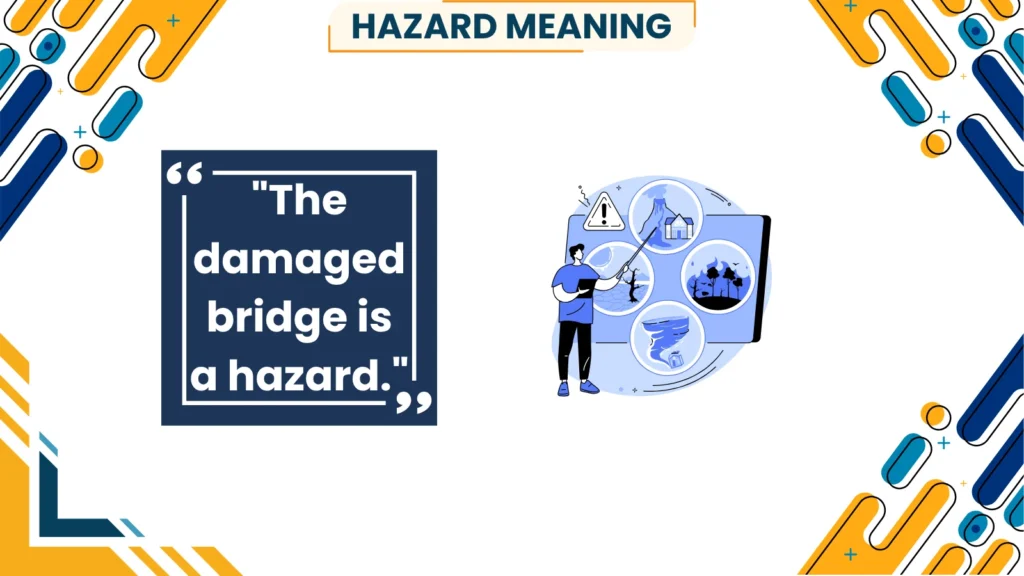
“The damaged bridge is a hazard.”
“Smoking is a health hazard.”
“Cybersecurity threats are becoming a growing hazard.”
Incorrect:
“I hazard my dinner every evening.”
(The word doesn’t fit this context.)
Common Situations Where Hazard Is Used
Safety Discussions
- Workplace safety
- School safety
- Home safety
Health Conversations
- Health hazards
- Environmental hazards
- Disease-related hazards
Transportation
- Road hazards
- Traffic hazards
- Weather hazards
Online Security
- Cyber hazards
- Data security hazards
Examples of Hazard in Conversations
Here are some real-life examples showing how people use the word.
Example 1: At Work
Employee: “There’s a loose cable near the entrance.”
Manager: “Thanks for reporting the hazard.”
Example 2: At Home
Parent: “Don’t leave toys on the stairs.”
Child: “Why?”
Parent: “Because they create a hazard.”
Example 3: Driving
Driver 1: “The road is covered in ice.”
Driver 2: “That’s a serious hazard.”
Example 4: Online Security
Friend: “I clicked a suspicious link.”
Friend 2: “That’s a cybersecurity hazard.”
Example 5: Social Media
User: “Sharing personal information publicly can become a hazard.”
Funny and Relatable Hazard Scenarios
Let’s make the concept easier to remember.
The Lego Hazard
Anyone who has stepped on a Lego brick barefoot knows:
“A Lego on the floor is a tiny hazard with massive consequences.”
The Charging Cable Trap
Ever walked through a room and nearly tripped over a charger cable?
That’s a hazard many people experience daily.
The Mystery Water Spill
You spot water on the kitchen floor and think:
“Looks harmless.”
Five seconds later:
“Oops.”
That’s exactly why hazards matter.
Common Mistakes and Misunderstandings
Many people misuse the word hazard.
Mistake 1: Confusing Hazard With Risk
As discussed earlier:
- Hazard = source of danger
- Risk = likelihood of harm
Mistake 2: Assuming Every Hazard Causes Harm
A hazard only has the potential to cause harm.
Example:
A wet floor is a hazard.
If nobody walks on it, no injury occurs.
Mistake 3: Ignoring Small Hazards
People often overlook:
- Loose cords
- Minor spills
- Weak passwords
Small hazards can sometimes lead to major problems.
Hazard in Different Industries
The term is used differently across professions.
Construction
Examples:
- Falling objects
- Unsafe scaffolding
- Heavy machinery
Healthcare
Examples:
- Infectious diseases
- Biological materials
- Sharp instruments
Information Technology
Examples:
- Malware
- Phishing attacks
- Data breaches
Manufacturing
Examples:
- Moving equipment
- Chemical exposure
- Noise pollution
Related Words and Terms
If you’re researching hazard meaning, you may also encounter these related terms.
Danger
An immediate threat.
Risk
Likelihood of harm occurring.
Threat
Something capable of causing damage.
Safety
Protection from hazards.
Precaution
An action taken to prevent harm.
Warning
A notice about a potential hazard.
Related Slang and Internet Terms
Although hazard isn’t internet slang, readers often search for similar terms.
You may also want to learn:
- Sus meaning
- Cap meaning
- No cap meaning
- Bet meaning
- NPC meaning
- IRL meaning
- POV meaning
- AFK meaning
- IMO meaning
- TBH meaning
Internal Linking Suggestions
- What Does Sus Mean?
- No Cap Meaning Explained
- POV Meaning on TikTok
- AFK Meaning in Gaming
- TBH Meaning in Text Messages
Why Understanding Hazard Matters in 2026
As technology advances, new types of hazards continue to emerge.
Examples include:
- AI-related security risks
- Deepfake scams
- Online privacy threats
- Digital fraud schemes
- Cybersecurity vulnerabilities
Understanding hazards helps people:
- Stay safe
- Make informed decisions
- Protect personal information
- Reduce accidents
- Improve workplace safety
In 2026, recognizing hazards is more important than ever.
Frequently Asked Questions (FAQs)
1. What is the simple meaning of hazard?
A hazard is anything that could potentially cause harm, injury, damage, or loss.
2. Is hazard the same as risk?
No.
A hazard is the source of danger, while risk is the likelihood that harm will occur.
3. Can a hazard be harmless?
A hazard has the potential to cause harm, but it may never actually result in damage.
4. What are common workplace hazards?
Common workplace hazards include:
- Slippery floors
- Exposed wiring
- Heavy machinery
- Chemical exposure
- Excessive noise
5. What is a health hazard?
A health hazard is something that may negatively affect a person’s physical or mental health.
6. What is a road hazard?
A road hazard is any condition that can make driving unsafe, such as debris, ice, potholes, or poor visibility.
7. Is hazard a negative word?
Generally yes. It usually refers to danger, risk, or a potentially harmful situation.
8. Why do people search for hazard meaning?
People search for hazard meaning to better understand safety warnings, workplace regulations, news reports, educational materials, and everyday conversations.
Conclusion
Understanding hazard meaning is essential because the word appears in many areas of daily life, from workplace safety and health discussions to transportation, technology, and online security.
Simply put, a hazard is anything that has the potential to cause harm.
As we move through 2026, awareness of both physical and digital hazards continues to grow.