If you’ve ever filled out an online form, ordered something from Amazon, or tried to sign up for a service, you’ve definitely been asked for a postal code.
And if you paused for a second thinking,
“Wait… what even is that?”
you’re not alone.
Understanding the postal code meaning is more important than most people realize, especially in today’s digital world where shipping, location tracking, and online verification depend heavily on it.
Whether you’re shopping online, sending mail, or filling out social media profiles, postal codes quietly power a huge part of global communication and logistics.
In this guide (Updated for 2026), we’ll break down everything you need to know in simple, human language.
What Does Postal Code Mean? (Definition & Origin)
A postal code is a series of letters, numbers, or both that identifies a specific geographic area for mail delivery.
In simpler terms:
A postal code is like an “address shortcut” that helps mail and packages reach the right place faster.
📌 Origin of Postal Codes
Postal codes were introduced to make mail sorting easier as cities grew larger and more complex. Before postal codes existed, mail delivery relied entirely on writing out full addresses, which often led to delays and mistakes.
Different countries have different systems:
- USA uses ZIP codes
- UK uses postcodes
- Canada uses alphanumeric postal codes
- Pakistan, India, and many Asian countries use numeric formats
For example:
- USA: 10001 (New York)
- UK: SW1A 1AA (London)
- Pakistan: 46000 (Islamabad region)
So when we talk about postal code meaning, we’re basically talking about a global system designed to organize locations efficiently.
Why Postal Codes Are Important in 2026
Postal codes are no longer just for mailing letters. In 2026, they play a much bigger role in digital systems.
✔️ They help with:
- Fast delivery of online orders
- Accurate location tracking on apps
- Fraud prevention in online payments
- Setting service availability (like Uber, food delivery, etc.)
- Personalizing content and ads
For example, when you order food on an app, it uses your postal code to decide:
- Which restaurants are near you
- Estimated delivery time
- Whether delivery is available at all
Without postal codes, modern logistics would be extremely slow and inaccurate.
How to Use Postal Code in Texts, Forms, and Online Systems
While postal code meaning is simple, many people still get confused about where and how to use it.
💡 Here’s where you’ll typically use it:
1. Online Shopping
When ordering products, you’ll be asked:
- Street address
- City
- Postal code
This ensures the delivery reaches your exact location.
2. Social Media Profiles
Platforms like Instagram, Facebook, and TikTok sometimes use postal codes for:
- Local trends
- Nearby recommendations
- Location-based ads
3. Banking and Payments
Banks use postal codes to:
- Verify identity
- Prevent fraud
- Match billing addresses
4. Government Forms
Used in:
- Passport applications
- Tax filings
- ID verification systems
Examples of Postal Code Usage in Conversations
Even though postal codes aren’t “slang,” they still show up in everyday digital communication.
📱 Example 1: Online Shopping Chat
User: Can you ship it to my area?
Seller: Yes, just send your postal code.
📱 Example 2: Delivery App
App: Enter your postal code to find nearby restaurants.
📱 Example 3: Customer Support
Support: Please confirm your postal code for verification.
😂 Funny Real-Life Scenario
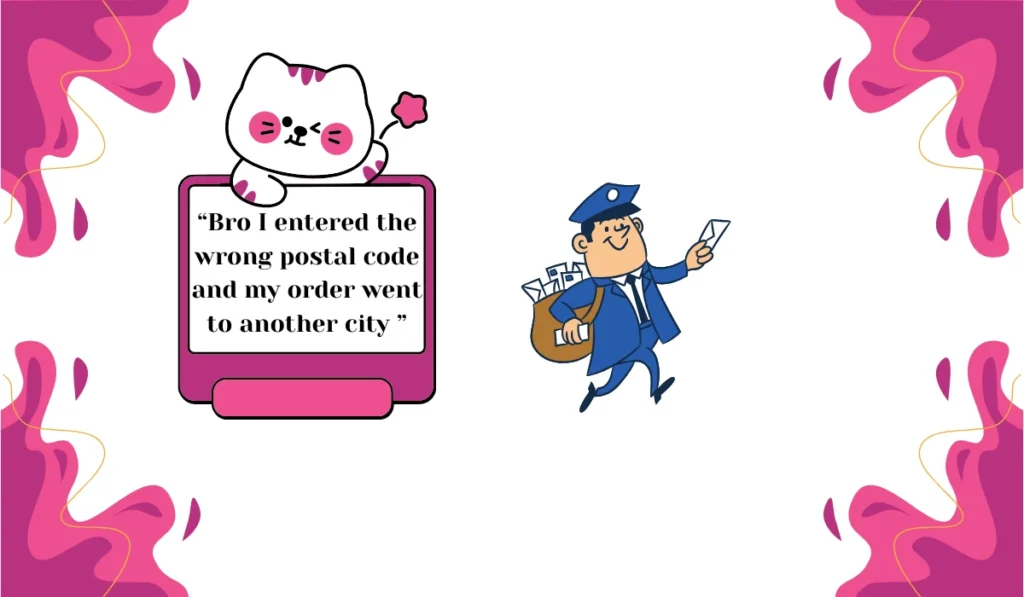
You might have seen someone say:
“Bro I entered the wrong postal code and my order went to another city 💀”
It happens more often than you think!
Common Mistakes or Misunderstandings About Postal Codes
Even though the concept is simple, people still make mistakes when using postal codes.
❌ Mistake 1: Confusing Postal Code with City Name
A postal code is NOT the same as a city.
A city can have multiple postal codes.
❌ Mistake 2: Using the Wrong Format
Different countries use different formats:
- USA: numbers only
- UK: letters + numbers
- Other countries: mixed systems
❌ Mistake 3: Leaving It Blank
Many users skip postal codes thinking it’s optional but it often leads to:
- Failed deliveries
- Incorrect shipping routes
- Verification errors
❌ Mistake 4: Guessing the Code
Guessing can cause serious issues in shipping or identity verification systems.
Related Terms and Variations of Postal Code Meaning
To fully understand the postal code meaning, here are related terms you might come across:
📦 ZIP Code
Used mainly in the United States. ZIP stands for “Zone Improvement Plan.”
📦 Postcode
Common in the UK, Australia, and some Commonwealth countries.
📦 PIN Code
Used in India. PIN stands for “Postal Index Number.”
📦 Area Code (not the same)
Used for phone numbers, NOT mail delivery.
Why Postal Codes Matter More in Digital Life (2026 Update)
In 2026, postal codes are deeply integrated into:
- AI-driven delivery systems
- Drone delivery mapping
- Real-time logistics tracking
- E-commerce automation
Even apps like Google Maps and Uber Eats rely on postal codes to improve accuracy.
So while it may look like just a random number, it’s actually a key part of the global digital infrastructure.
Quick Summary of Postal Code Meaning
To put it simply:
- A postal code identifies a geographic location
- It helps deliver mail and packages correctly
- It is used in online shopping, banking, and apps
- Different countries use different formats
- It is essential for modern digital services
FAQs
1. What is a postal code in simple words?
A postal code is a number or code that identifies a specific area for mail delivery.
2. Is postal code the same as ZIP code?
Yes, but “ZIP code” is specifically used in the United States, while “postal code” is a global term.
3. Why do websites ask for postal codes?
They use it for delivery, location services, and identity verification.
4. Can two cities have the same postal code?
No, each postal code is assigned to a specific area.
5. What happens if I enter the wrong postal code?
Your mail or package may be delayed, misdelivered, or returned.
6. Is postal code important for online shopping?
Yes, it is essential for accurate and fast delivery.
7. Do all countries use postal codes?
Most countries do, but formats vary widely.
8. Can I find my postal code online?
Yes, you can search it using Google Maps or your country’s postal service website.
Conclusion
Understanding the postal code meaning is more important than it looks.
It’s not just a random number you enter on forms it’s a critical part of global communication, logistics, and digital services.
From online shopping to banking verification, postal codes ensure everything reaches the right place at the right time.
As technology continues to evolve in 2026, their importance is only increasing.
If you’ve ever had a funny or frustrating experience with a postal code mix-up, you’re definitely not alone it happens more often than people admit!
👉 Share your favorite text abbreviation or confusing online term in the comments you might help someone else understand it too!